Picking a distribution
Versatility of Weibull
When in doubt regarding what distribution to pick: we can highly recommend starting off with a
Weibull distribution. It's one of the most versatile distributions
due to its shape parameter alpha. This shape parameter allows for easy tweaking of the failure
distribution over time, whilst keeping your mean time between failure constant. In fact, by setting
the shape parameter to specific values, the distribution reduces to some other standard distributions!
See the Weibull distribution Wikipedia page for more info.
So let's say:
- your mean time between failure or MTBF is 10 years and you would want to review the cumulative failure probability.
- we start at year "0" and look forward 50 years.
- we want to experiment with the shape parameter.
- we want to highlight a threshold where 50% of the components is expected to have failed.
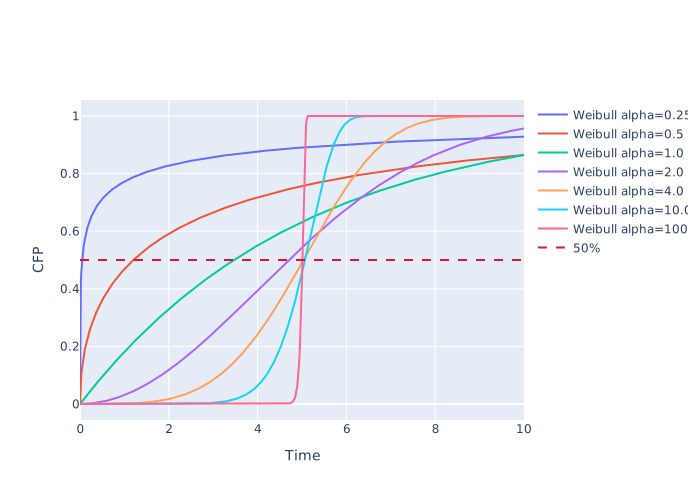
Note that even though some distributions appear to fail "faster", their mean time between failure is all equal to 10 (years) in this case. Their CFP rises quickly initially, but remains relatively lower the further time progresses to even this out, i.e. components fail fast or just keep ploughing on.
Determining or assuming values
Now you still might be guessing what values you should use? The answer is: it depends on a lot of things! If you don't have any experimental data or datasheets dictating what values to use or assume, you will have to start by defining what failure means in your specific use-case.
Then you can start looking for a suitable shape that corresponds to that failure behavior. A neat
aspect of the Weibull is that the shape parameter alpha and the
Mean Time Between Failure mtbf are independent such that the shape will simply "stretch out" if
you pick a longer mtbf. In general, a low shape alpha (>0.0) means more early failures and a
higher alpha results in more failures around the mtbf. In case of an extremely high alpha, it
approaches a step function around the mtbf.